How the City of Bismarck helps control traffic is always evolving. From the stop sign to mechanical timing mechanisms used decades ago, and then to signals that were tied to one another, but couldn’t be part of a larger system, traffic control is again experiencing a renaissance of control. Recent projects have brought fiberoptic cable into the City/County Building and have opened many possibilities for the future of the city’s traffic control.
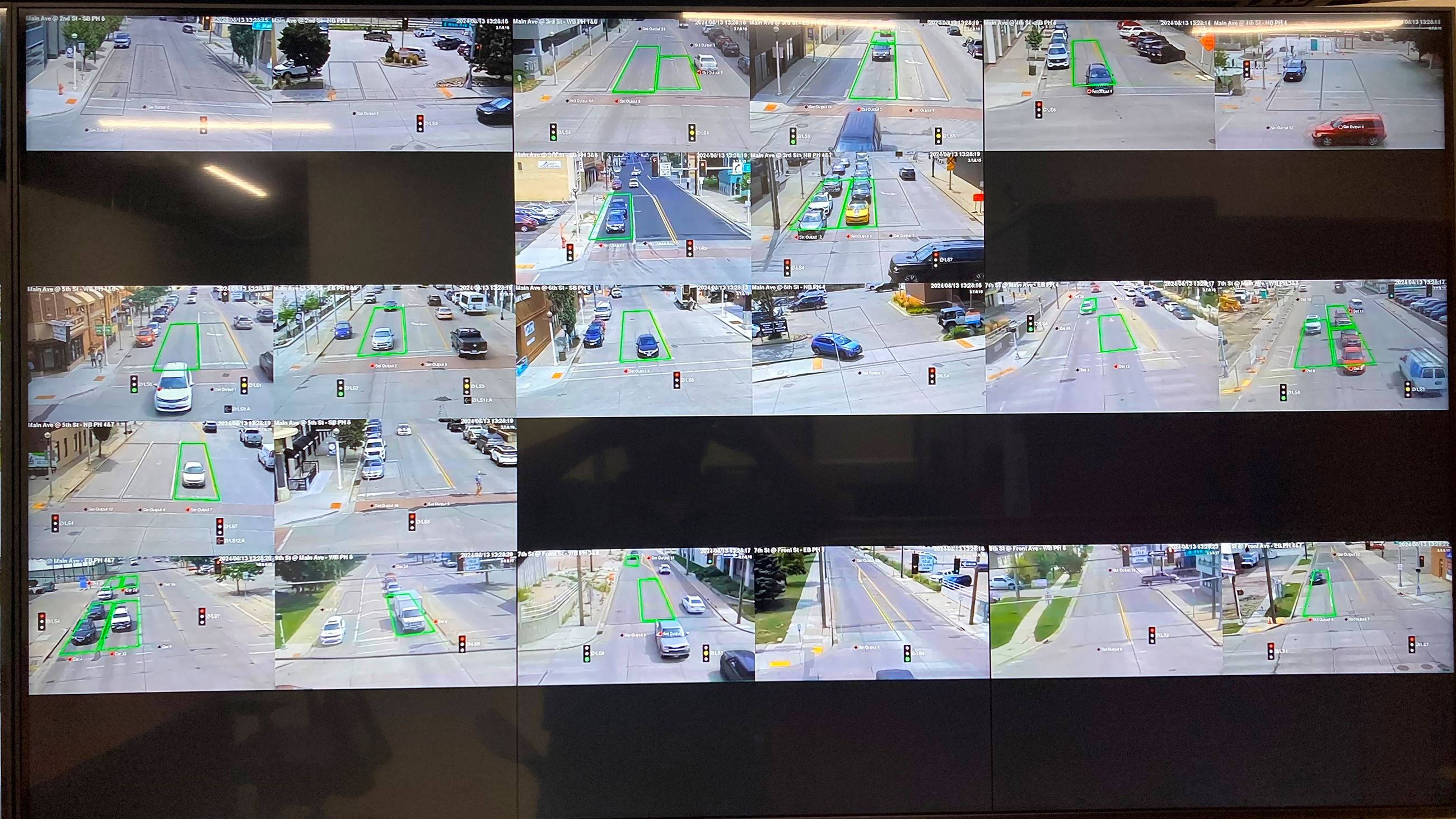
Bismarck Traffic Engineer Christopher Holzer is tasked with making sense of the overwhelming data that is now available at the over 55 intersections plugged into Centracs, a cloud-based software that connects to our traffic signals, controllers and cameras to give staff visibility in the field and allows staff to alter traffic patterns. In total 109 intersections in Bismarck are governed by traffic signals.
“Traffic control is a whole package and Centracs is part of the package,” said Holzer. “Having the remote communications out to the traffic signals is a great help. We can get the detection cameras to stream live video and if something isn’t working, we can see why. You can take detection information and create graphs and charts and see what the average delay is at an intersection but you need that remote connectivity to make it all work.”
Throw in a traffic crash or landslide that closes a road, or summer road construction that alters traditional traffic flows, and everything else that can impact traffic patterns, and you can begin to see how complex an issue traffic control is. As Bismarck continues to grow and its traffic needs evolve, the system is expected to only become more complex and interconnected.
Traffic Control
 The philosophy of traffic control is fairly straightforward in that priorities are placed on safety and efficiency. Negotiating traffic is a large-scale trust exercise in many instances.
“The best traffic control is something that is easily understood by the public,” said Holzer. “They know what they are supposed to do, and it works efficiently to get them through an intersection safely.”
But several things can unbalance this delicate dance.
“When mainline has more traffic than the side street, we give more green time to mainline, which causes the side street to wait longer,” said Holzer. “Another thing would be distracted driving. We time the signals to get a certain number of vehicles through, but if drivers are texting when they get their green arrow, maybe only one or two cars can get through.”
Emergency response can also impact the flow of traffic in multiple ways. Initially, there is disruption when a first responder’s vehicle preempts a traffic signal and allows that response to go to its destination without interruption. But there is also a secondary impact in which it may take a series of cycles for the traffic control to synchronize back into coordination with other signals. Someone approaching an intersection 30 or 40 seconds after a firetruck has preempted a signal and made its way through the intersection may not see or hear that emergency response vehicle, but it feels the ripples left in its wake.
Centracs does offer AI solutions to traffic control and Holzer said the system will offer suggestions throughout the day on ways it can counter traffic abnormalities it perceives. At this point, the plan is not to simply flip the switch and let AI make all decisions, but it does offer another point of view for the data collected.
“Some of the quirks are still being worked out. It’s not quite all there yet, but it is close,” said Holzer. “It’s almost ready to be very helpful. Humans still set the timings, but in the future, as things keep improving, maybe it is the system making some of these decisions and humans are just overseeing things.”
An AI-assisted driving experience is not likely to be noticeable versus the human-guided approach, however.
“When things are working well, people rarely notice,” said Holzer. “It’s when things are working poorly, people notice: Why am I at this red light when there is no one on the cross street or why am I stopping at every single red light.”
This system also allows for different timing plans to be used throughout the day to match the expected traffic patterns. Reports can be generated to look at the traffic flow in 15-minute increments. Traditionally, those highest traffic volumes occur from 7:30 AM to 8 AM, and 4 PM to 6 PM. Holzer will use up to 10 or 11 different timing plans throughout the day to take into consideration expected traffic increases. When everything is working correctly, though, the data the system uses is what can help drive on-the-fly adjustments to the traffic control system. If and when someone does have complaints, Holzer is able to often pull up that intersection camera, dissect the problem and begin to work on a remedy.
The system is not perfect, though. Ways the automated system may be tricked are as varied as the environment of a North Dakota spring, summer, fall or winter. During the winter, it could be that the camera is iced over and obscuring the view of the intersection. Or, the detection zone, an area designated in the system as the alert area, doesn’t line up with traffic flow due to weather conditions such as a large snow drift. Some detection zones could also be tricked by movements that include overgrown trees swaying in the wind, an east-facing camera impacted by direct sunlight in the morning, or street lighting that reflects off a wet roadway in the evening.
IT & Hardware
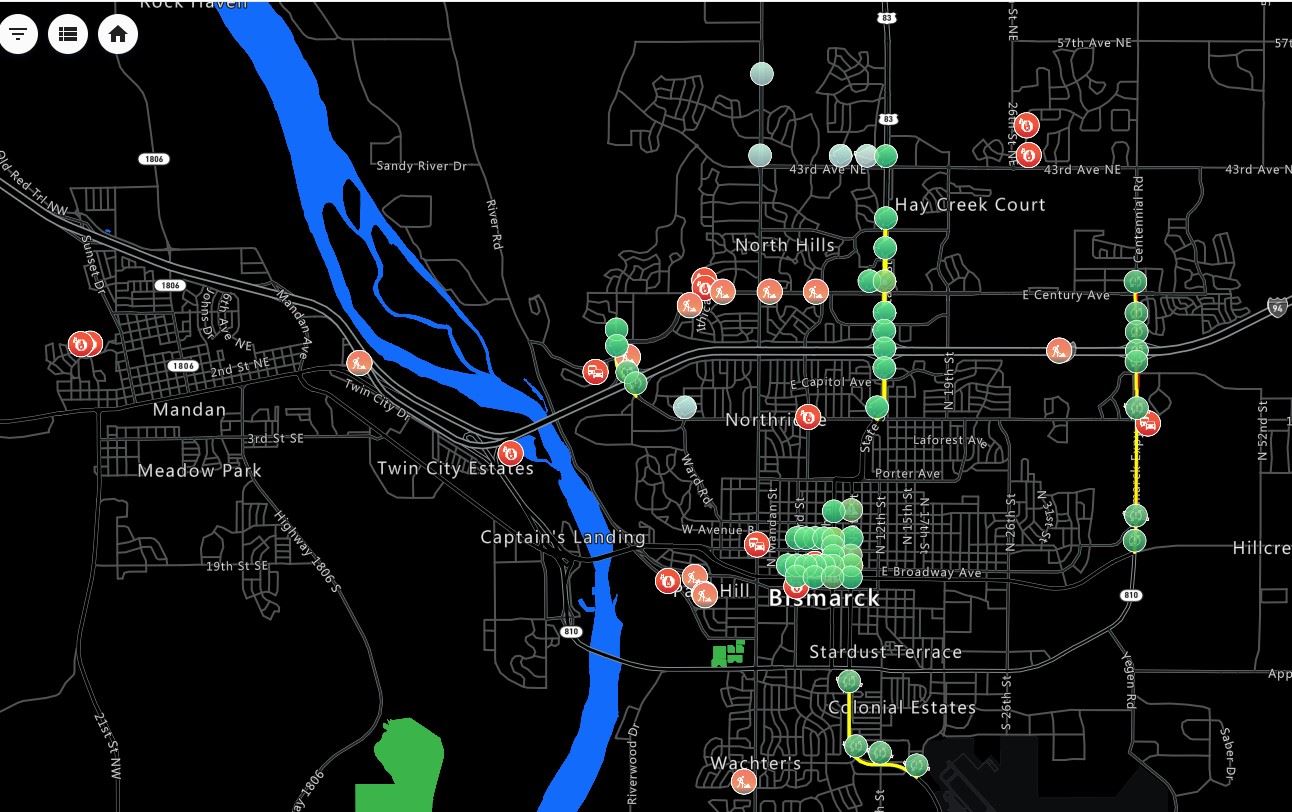 When Traffic Maintenance Superintendent Paul Lies began working for the City of Bismarck in the early 1990s, traffic control was conducted by timing mechanisms of gears and sprockets. Traffic signal systems could be tied together, but if something went wrong at an intersection, a technician would need to physically go to that location to diagnose what was wrong.
“Today they are basically computers,” said Lies. “But with that comes the task of updating that equipment every five years. Right now, some of the video equipment that we have out there is 20-plus years old. Doing that would be really cool, but it would be a big budget change for the City to adjust to if that is what they want to do.”
The first iteration of video connectivity in intersections was through twisted pair copper connections. But today that infrastructure is transitioning to fiber optic networks.
“Right now, that infrastructure is sort of similar to what we are doing with IT throughout the City: Let’s start to standardize what we are doing,” said Bismarck IT/GIS Manager Tandra Kraft. “Some of the cameras used at intersections were getting to a point where they were old enough that their software was no longer compatible with our servers.”
By needing to update equipment more frequently, each time crews work at an intersection there is adherent risk to staff, equipment and the traveling public as lanes may be blocked off or the traditional traffic flow is temporarily altered.
“That is one of our big things: We try to make our impact on the roads as little as possible,” said Lies. “That is one reason we went to 15-year LEDs on our reds, yellows and greens. Before, the lights had a life expectancy of five to seven years.”
Lies has a goal of adding about 10 intersections a year to the Centracs system, which means a growing network of fiberoptics, running throughout the City. When the City of Bismarck purchased a server for the Centracs system, bringing fiberoptic cable into the building became a necessary upgrade. The project began in 2022 in concert with work the North Dakota Department of Transportation was doing on Seventh and Ninth Streets. The final fiber was run to the building in 2023.
Fiberoptic cables are bundles of glass or plastic threads transmitting information as light impulses. These cables allow for higher speeds on a larger number of devices that have a higher quality of graphic because the transmission of data is so much greater than other mediums. For instance, when you run copper Cat6 cable, an ethernet cable to the layperson, the maximum length you can run the cable is just shy of the length of a football field, about 100 meters, without a repeater, according to Kraft. To contrast, fiber can be run 62 miles without losing signal strength.
“When I was working in the field, and I would be on call, you would get called all the time. Now there are times you don’t get called because things are running better,” said Lies. “We are trying to keep our equipment modern and keep it in good shape. We are also trying to make things uniform, so it is easier to troubleshoot and staff only needs to know one kind of controller instead of four or five different brands.”
In the fall, staff inspect and clean up the cabinets and install heaters that will get the computer systems through a North Dakota winter. In the spring, the heaters are swapped for a filter that helps run moving air through the cabinet to keep temperatures lower. This regular maintenance helps ensure the traffic signals are always ready for when they are needed most.
First Responders
 The Bismarck Fire Department is cognizant of traffic patterns every time a fire truck and firefighters leave a fire station. There is a lot of activity happening in a fire engine, as far as communication and activity, as it leaves a station.
“When we are responding, we are recognizing ourselves as creating change and change could create chaos,” said Bismarck Fire Chief Joel Boespflug. “We try to be conducive to traffic patterns, but if we are in the middle of heavy traffic, there are things we need to do.”
Part of this response, allows the responding fire engine to control an intersection, with an Emergency Vehicle Preemption device. This device gives emergency vehicles green lights.
“It is a very valuable tool for us,” said Boespflug. “A fire engine is about 55,000 pounds and a ladder truck is probably in excess of 95,000 pounds. They don’t stop on a dime.”
The most recent fire engines purchased by the City of Bismarck included a price tag of about $1.2 million, while a ladder truck costs about $2.5 million. However, alongside the cost of the apparatus is the three-year delay it takes from the time you place an order, to the time you receive the equipment. By protecting the equipment at intersections, the Fire Department is ensuring the availability of equipment for fire response for the entire community.
When a fire engine from Station 4, on Miriam Drive to the east of Bismarck Expressway responds, the crew on the fire engine grabs control of that intersection’s signal. If the response will go north, the system triggers green lights to the north to help clear traffic out of the way for that incoming vehicle. At Station 3 on Tyler Parkway, when the bay doors open for the engine to leave the station, the engine grabs control of the signal so when it turns east, the green light should be clearing traffic ahead.
“Emergency response time is crucial, but safety is the highest priority,” said Boespflug. “I think this makes it a safer response for us and it protects the public. I don’t know how we could operate without them. Bringing that truck to a complete stop would hamper that response time. But we do recognize, too, that when we do activate it, it knocks their system out of sync for a little bit.”
A momentary or more substantially out-of-tune traffic control system can have impact on the individuals who enforce traffic laws as well as the driving public. Within the city limits of Bismarck, this traditionally falls on Bismarck Police Department’s Traffic Division. In 2022, Bismarck had 17 of the top 50 dangerous intersections in the state.
“(In August and September) we have a lot of road construction, and it seems like a lot of arterials become impacted because of it,” said Lt. Jeff Solemsaas. “One tool I use is collision reports. Bismarck sees about 3,200 to 3,500 collisions in a year and that averages out to about 10 collisions in Bismarck a day. If we start to see a problem area, we can work with Engineering to try to make changes to what could be causing collisions. Two years ago, we started having a problem on State Street, south of 43rd Avenue. There was a slinky effect with a green light on Calgary. When we made a change to the timing, the crashes fell off.”
If you look at a three-year average, Bismarck’s most dangerous intersection is the convergence of State Street and 43rd Avenue. However, this average is impacted by a high of 54 incidents in 2021. In 2023, that intersection had just 16 incidents. That is followed by Main Avenue and Seventh Street, which had similar incidents of 23 in 2021, 16 in 2022 and 21 in 2023. The intersection of State Street and Century Avenue has shown gradual decreases from 35 incidents in 2021, 30 in 2022 and 27 in 2023.
“The more heavily traveled roads have a higher rate of collisions,” said Solemsaas. “We try to reduce that with the use of traffic control. We work closely with Engineering to reduce traffic collisions. Right now our most common collision is a rear-end collision. That is 25 percent of our collisions.”
As traffic data from 2024 becomes available, the early returns on traffic control changes can begin to be evaluated. Traffic statistics are always challenging in North Dakota because weather-related anomalies can also impact data, such as when BPD was swamped with about 200 crashes due to an ice storm that slammed much of the state at the end of 2023. But, as the timeline extends, we are hopeful to see this marrying of technology and city-led effort and expertise to make a safer infrastructure of roadways for our citizens, our visitors and our community as a whole.